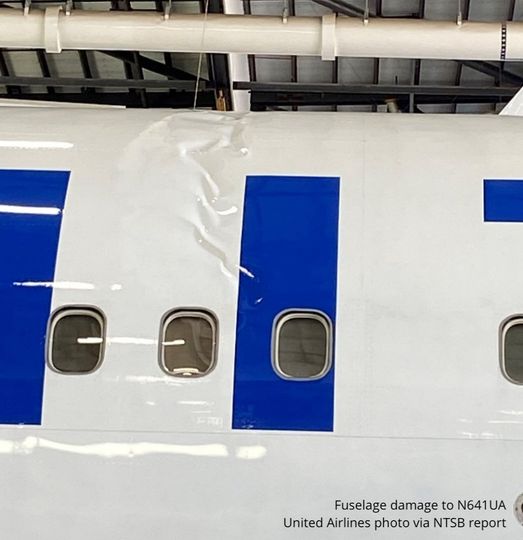
Questo è il preliminary report emesso da NTSB sull’incidente del Boeing 767-322ER United Airlines del 29 luglio 2023, quando un Boeing 767-322ER N641UA ha toccato la pista in modo tale da precluderne il suo futuro per i danni riportati alla struttura dell’aeromobile, poi dichiarato fuori uso di non conveniente riparazione.
Questa è la sua traduzione del report preliminare emesso:
Il 29 luglio 2023, verso le 10:34 ora legale (CDT), il volo United Airlines 702, un Boeing 767-322(ER), N641UA, ha subito danni sostanziali quando è stato coinvolto in un incidente durante l’atterraggio all’aeroporto intercontinentale George Bush (IAH ), Houston, Texas. I 202 passeggeri e l’equipaggio a bordo sono rimasti illesi. Il volo operava come un volo passeggeri nazionale di linea 14 Code of Federal Regulations Part 121 dall’aeroporto internazionale di Newark Liberty (EWR), New Jersey, a IAH.
L’equipaggio di volo ha riferito che il primo ufficiale (FO) era il pilot flying e il Com.te era il pilot monitoring. La partenza da EWR e il segmento di crociera del volo sono stati tranquilli. All’arrivo all’IAH, sono stati autorizzati con la STAR DOOBI2 e all’avvicinamento ILS 26L. Secondo l’equipaggio di condotta, l’aereo era completamente configurato per l’atterraggio, in velocità e in conformità con i criteri di avvicinamento stabile della compagnia e l’atterraggio iniziale sulle ruote principali era normale. Il FO ha dichiarato che dopo che il carrello di atterraggio principale ha toccato la pista, ha mantenuto la pressione a poppa sul volantino per impedire alla ruota anteriore di colpire la pista; tuttavia, la ruota anteriore è entrata in contatto con una forza anomala. L’aereo sembrò rimbalzare e lui reagì tirando a poppa il volantino, nel tentativo di impedire alla ruota anteriore di urtare la pista una seconda volta. Successivamente, gli airbrakes si sono attivati e la frenata automatica si è innestata, il che ha provocato un secondo rimbalzo della ruota anteriore. Ha dispiegato gli inversori di spinta e l’aereo ha iniziato a decelerare. Il capitano ha assunto il controllo dell’aereo e il resto del rollout dell’atterraggio è stato normale senza alcun rischio di superamento della pista o escursione.
Una revisione preliminare del registratore dei dati di volo (FDR) ha rivelato che dopo l’atterraggio iniziale su entrambe le ruote principali, l’aereo è andato verso sinistra e il carrello principale destro si è sollevato dalla superficie della pista. Successivamente, il carrello anteriore è atterrato con una forza gravitazionale equivalente (g) di circa 1,4 g ed è rimbalzato. gli airbrakes si sono attivati e il carrello anteriore ha colpito la pista una seconda volta con una forza di circa 1,6 g seguito da un altro rimbalzo. L’inversore di spinta (TR) è stato attivato e la ruota anteriore ha colpito nuovamente la pista con una forza di circa 1,6 g seguita dall’attivazione del TR sinistro.
Un esame post-incidente dell’aereo ha rivelato danni sostanziali alla corona della fusoliera superiore, vedi figura 1.
Location: Houston, TX
Date & Time: July 29, 2023, 10:34 Local
Aircraft: Boeing 767-322
Flight Conducted Under: Part 121: Air carrier – Scheduled
Accident Number: Registration: Injuries:
DCA23LA384 N641UA
202 None

On July 29, 2023, about 1034 central daylight time (CDT), United Airlines flight 702, a Boeing 767-322(ER), N641UA, sustained substantial damage when it was involved in an accident while landing at George Bush Intercontinental Airport (IAH), Houston, Texas. The 202 passengers and crew onboard were uninjured. The flight was operating as a 14 Code of Federal Regulations Part 121 scheduled domestic passenger flight from Newark Liberty International Airport (EWR), New Jersey, to IAH.
The flight crew reported that the first officer (FO) was the pilot flying and the captain was the pilot monitoring. The departure from EWR and the cruise segment of the flight were uneventful. Upon arrival at IAH, they were cleared for the DOOBI2 arrival and the ILS 26L approach. According to the flight crew, the airplane was fully configured for landing, on speed and in compliance with the company’s stable approach criteria and the initial touchdown on the main wheels was normal. The FO stated that after the main landing gear touched down, he held aft pressure on the control yoke to keep the nose wheel from hitting the runway; however, the nose wheel made contact with abnormal force. The airplane appeared to bounce, and he reacted by pulling aft on the control yoke, in an effort to keep the nose wheel from impacting the runway a second time. Subsequently, the speed brakes deployed, and the auto brakes engaged which resulted in a second bounce of the nose wheel. He deployed the thrust reversers, and the airplane began to decelerate. The captain assumed control of the airplane and the remainder of the landing rollout was normal with no risk of runway overrun or excursion.
A preliminary review of the flight data recorder (FDR) revealed that after the initial touchdown on both main wheels, the airplane rolled to the left and right main gear lifted off the runway’s surface. Subsequently, the nose wheel touched down with a gravitational force equivalent (g) of about 1.4 g and bounced. The speed brakes deployed, and the nose wheel impacted the runway a second time with a force of about 1.6 g followed by another bounce. The right thrust
reverser (TR) deployed, and the nose wheel impacted the runway again with a force of about 1.6 g followed by the deployment of the left TR.
A postaccident examination of the airplane revealed substantial damage to the crown of the upper fuselage, see figure 1.
Figure 1. Close up view of damage to the airplane (source: United Airlines).
Page 2 of 3 DCA23LA384 This information is preliminary and subject to change.
Aircraft and Owner/Operator Information
Aircraft Make: Boeing Registration: N641UA
Model/Series: 767-322 Aircraft Category: Airplane
Amateur Built:
Operator: Operating Certificate(s) Flag carrier (121) Held:
Operator Designator Code:
Meteorological Information and Flight Plan
Conditions at Accident Site: Condition of Light: Day
Observation Facility, Elevation: KIAH,90 ft msl Observation Time: 09:53 Local
Distance from Accident Site: 1 Nautical Miles Temperature/Dew Point: 30°C /23°C
Lowest Cloud Condition: Scattered / 2500 ft AGL Wind Speed/Gusts, Direction: 5 knots / , 220°
Lowest Ceiling: Broken / 25000 ft AGL Visibility: 10 miles
Altimeter Setting: 30.14 inches Hg Type of Flight Plan Filed: IFR
Departure Point: Newark , NJ Destination: Houston, TX


| Wreckage and Impact Information |
| Crew Injuries: 9 None Aircraft Damage: Substantial |
| Passenger Injuries: 193 None Aircraft Fire: None |
| Ground Injuries: Aircraft Explosion: None |
| Total Injuries: 202 None Latitude, Longitude: 29.989605,-95.344154 |
| Administrative Information |
| Investigator In Charge (IIC): Banning, David |
| Additional Participating Persons: Ryan Hurling; United Airlines Steve Demko; ALPAJohn Miller; Boeing Todd Gentry; FAA |
| Note: The NTSB did not travel to the scene of this accident. |
Page 3 of 3 DCA23LA384 This information is preliminary and subject to change.
 Italiavola & Travel